
How you write matters
A round-up of research comparing how our brains activate when handwriting and typing, and how research-led writers can maximise the brain benefits of good old-fashioned writing by hand.
A friend once told me she ‘thinks with her fingers’ as she types. As writers, we are both pretty much digital natives, drafting all our texts on keyboard and screen, with all the deleting and undo-ing that allows. The callous on the middle finger of my right hand has all but disappeared, so seldom do I write more than a few words with a pen. Gone are the days of scribbling solidly for a three hour exam, or drafting a handwritten essay ready to type up later. I’m now a solid touch typist, despite never having been trained, and can get the thoughts out of my head faster on a keyboard than I can write on paper. And that’s really important when I’m in flow.
Yet there are still tasks I prefer paper for. Taking notes about what I am reading, and preparing an important talk, for example – both of which require me to remember at least some of what I have written for later use. I also write copious notes during meetings because it helps me stay focused on what is being said rather than drifting off looking out of the window. So I guess I have always intuitively known that the physical act of handwriting is in some way connected to cognitive processes, but it’s only now that neuropsychologists are able to show these relationships actually happening inside our brains.
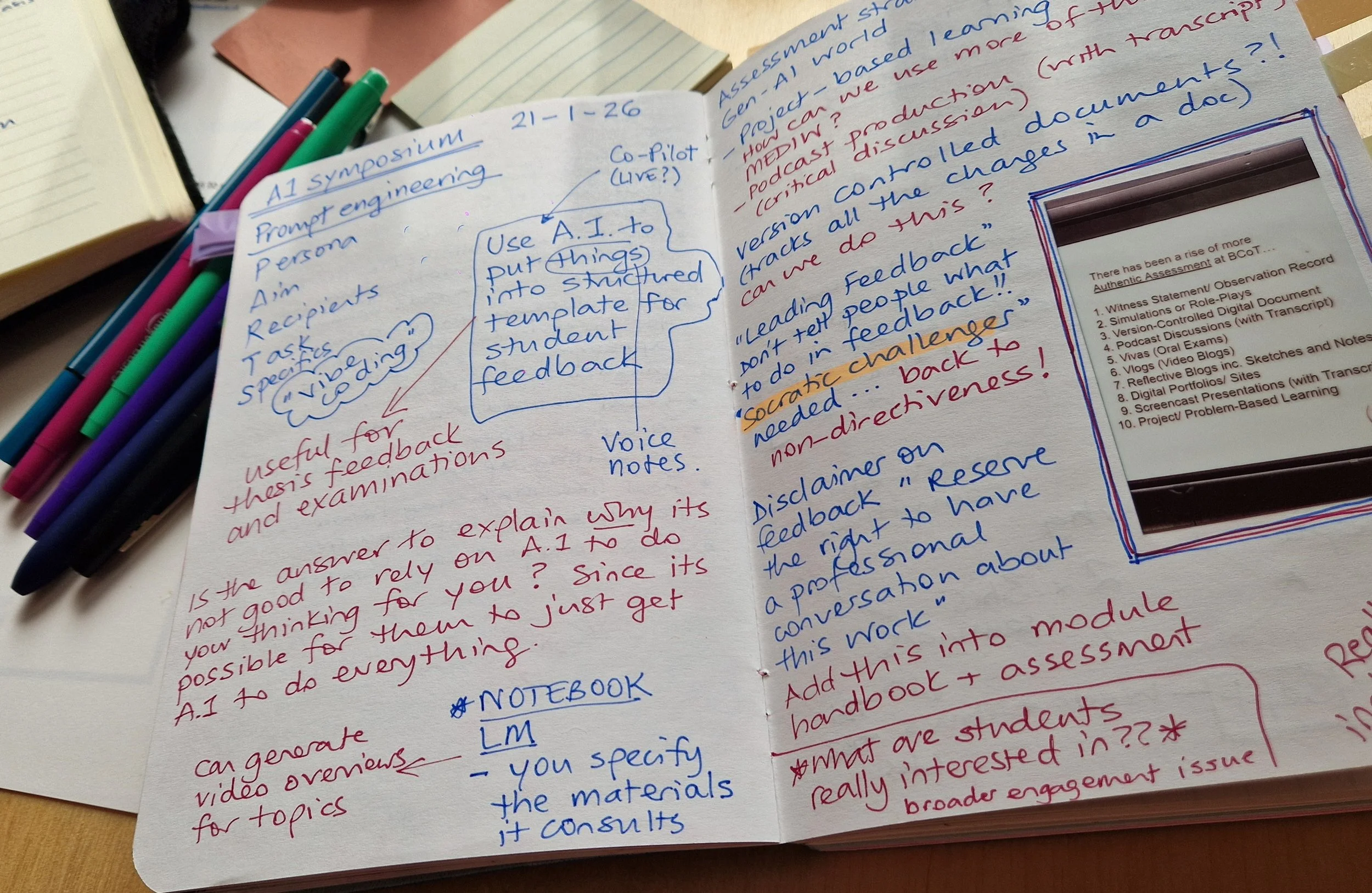
Some of my multi-coloured meeting notes
Brain imaging studies show that writing by hand simply activates more of our brain than typing does. It’s the precisely controlled hand movements when handwriting that are particularly important here, by moving and thinking, we are keeping our brains extra busy, forging new neural pathways and maintaining old ones. When we type, our brain shifts into a more passive cognitive mode and this has implications for overall brain health, particularly as we age.
Equally important is what those activated brain areas are doing when we write by hand. They are responsible for encoding memories and new information which are both essential for learning, and stock-in-trade for the research-led writer. A study of 9-13 year olds found handwriting to be particularly effective for learning to spell words correctly and another with undergraduates found that the additional effort of typing affected the brain’s ability to recall what was typed compared to a task executed by hand. The lesson here, then, is that if you want to remember it, write it out by hand.
Another study has found that the ways we think through language depend on whether we handwrite or type. When writing by hand, the linguistic processing happens progressively as we write but when we type, the processing happens before we touch the keys. This probably explains why letter-writing and journalling by hand often results in unexpected thoughts seeming to just flow out of the pen, and gives a good justification for why free-writing is so effective when done by hand. It also suggests that sadly, my friend’s fingers almost certainly weren’t ‘thinking’ on the keyboard after all.
Here’s some ways to get more hand-writing into your research-led writing life:
1. Left page/ right page note-taking.
When you’re reading, watching or listening to research materials, write facts, quotes, page numbers and time-stamps from the material on the left hand page of an open notebook, with your corresponding thoughts and impressions on the right hand page. For added usefulness, include how and where you might incorporate those impressions in your project.
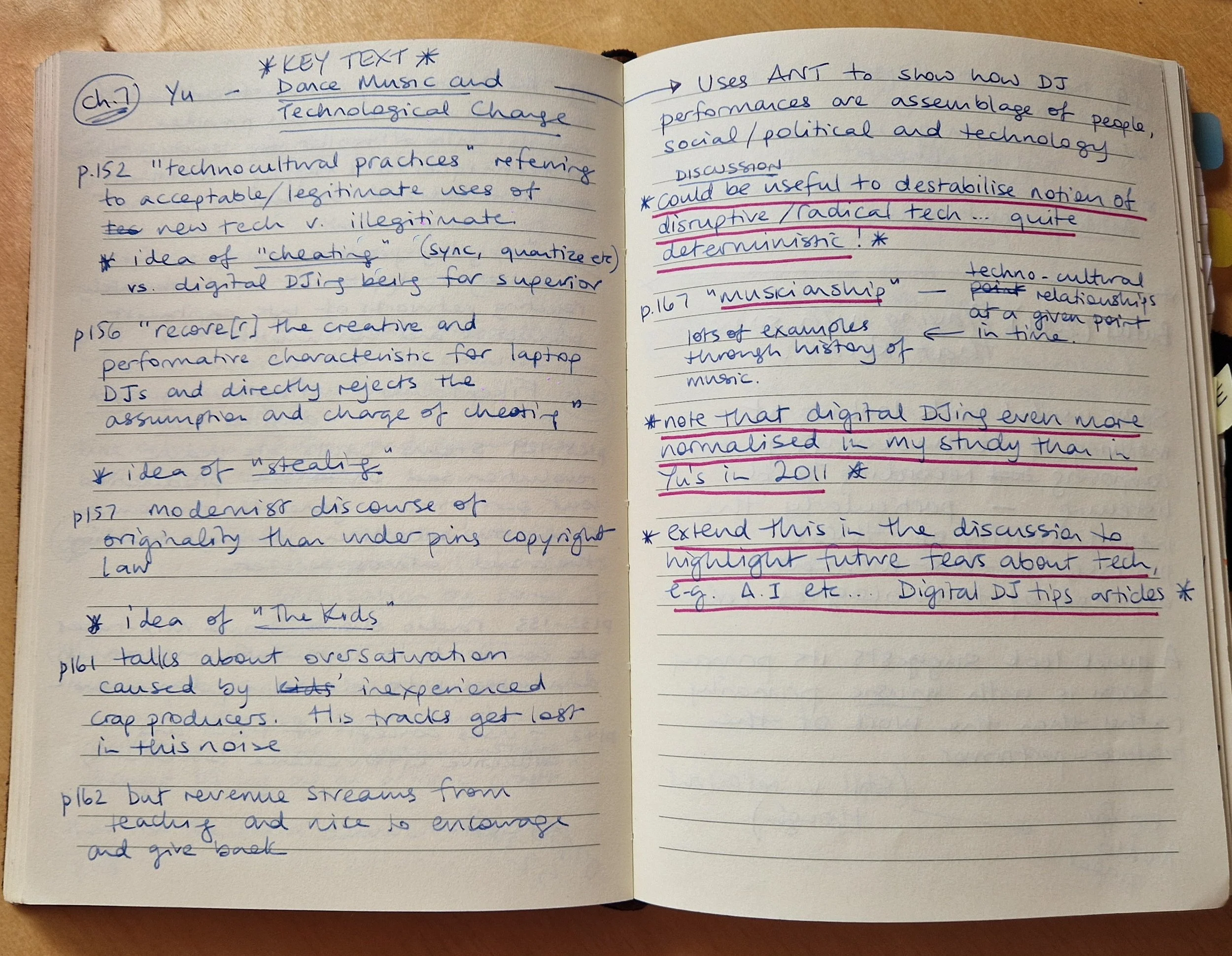
Left page/ right page notes on a book chapter
2. Handwrite yourself a script.
Not to read from, but to cement the content in your head. The presentations that seem the most casual and informal are usually the ones I’ve prepared for the most, and I do that by writing out sections exactly how I’d like to say them on the day. It never turns out that way, but the main points are locked in.
3. Free-write to start your writing sesh.
Grab a pen and paper and write without stopping for 5 or 10 minutes before you settle into your ‘proper’ writing task. Try writing what you want your reader to learn when they read what you’re about to write, or write to yourself explaining what it is you trying to do. If you get stuck, don’t stop, just keep writing any old thing and see what falls onto the page.
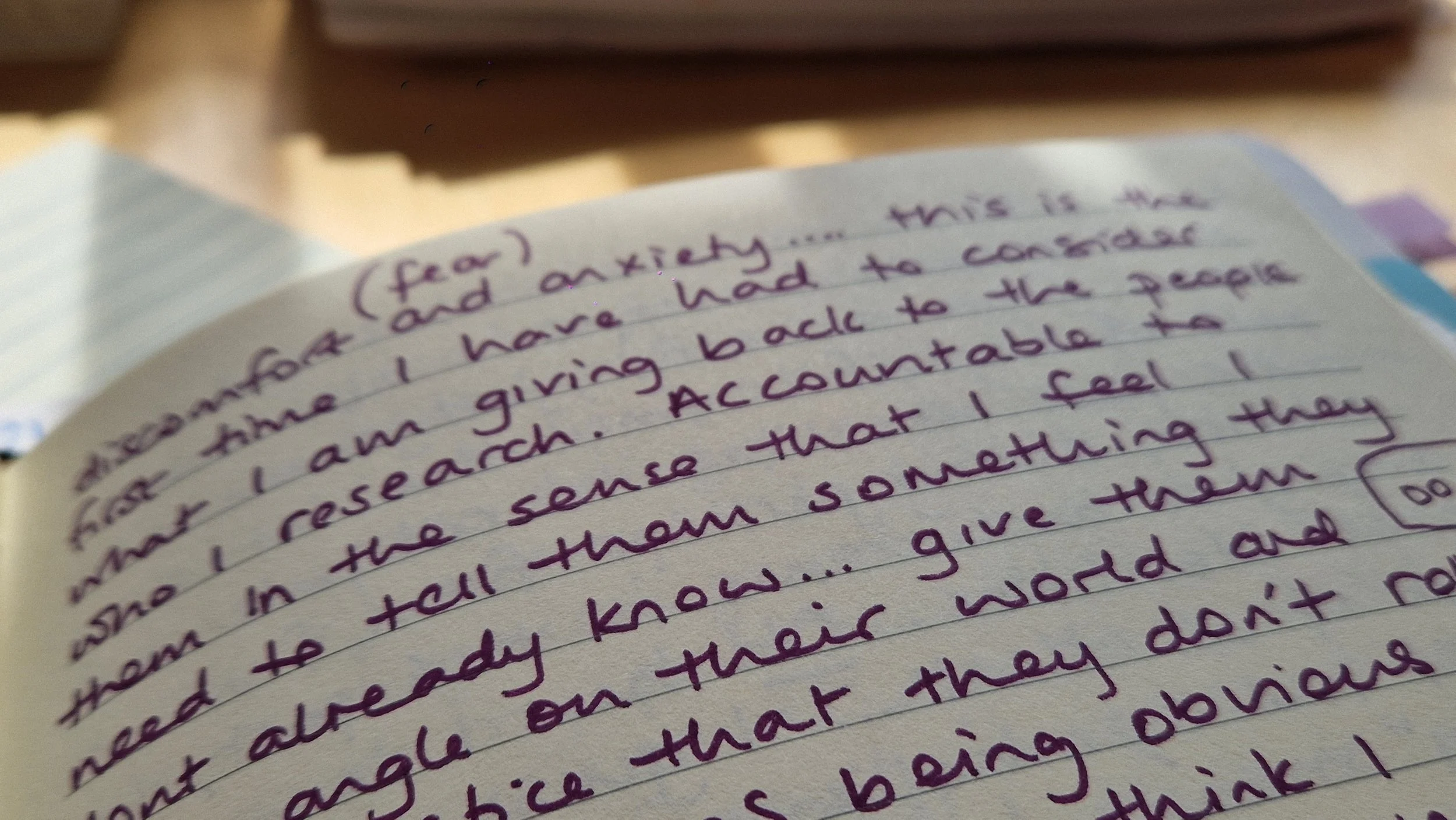
Free-writing about my anxieties
4. Try some new-fangled writing tech.
What if you could handwrite straight into your computer and convert it to typed text for your draft? Fantasy? No, that future is here in the form of ReMarkable tablets, and they even come in full colour. They feel like writing on paper and you can load up documents to scribble on. I’ve never used one, but my friend loves hers and I think I know what my next Curious View bonus is going to be when I reach my goals!
So next time you reach for the notes app on your phone, load up your online journal, or lift your laptop lid to start writing, ask whether handwriting might be a better option instead. Your brain just might thank you for it!